
The younger the applicant to our housekeeping roles, the more likely the candidate is to be a man. This is what more than 28,000 applications to our housekeeping jobs show.
Can a man be a housekeeper? Yes. 35% of the applications we receive for housekeeping jobs are from men. For applicants under 35, it’s 45%, which is almost half.
Morgan & Mallet, a luxury household staffing agency, places housekeepers in high-net-worth households across the United States.
These figures come from the applications people make to our own job adverts. Government job figures count housekeepers, but they don’t actually show who applies.
That’s where it gets interesting. The people applying for housekeeping jobs look very different from the people actually doing the role.
Below we look into how big the difference is, where in the world it’s highest, and what it means if you’re hiring.
The numbers at a glance
| Who we counted | Share who are men |
|---|---|
| Applications for our housekeeping jobs | 35% |
| Applications from people under 35 | 45% |
| Applications for housekeeping jobs in the UAE | 52% |
| Applications for housekeeping jobs in the US | 43% |
| Housekeeping staff in our candidate database | 17% |
| US maids and housekeeping cleaners (government figures) | 14% |
Source: Morgan & Mallet recruitment data and candidate database, January 2022 to October 2026; US Bureau of Labor Statistics, 2025. See how we count.
One job, two very different pictures
Men make up 17% of the housekeeping staff in our database, but they are 35% of the people applying for our housekeeping jobs. The applicants are twice as likely to be men as the people already doing the work.
The workforce figure is close to what the US government sees. In our database, 14% of housekeepers (not counting head housekeepers and housekeeper-cooks) are men.
According to the Bureau of Labor Statistics, 86% of US maids and housekeeping cleaners are women, so about 14% are men. The number of male applicants to private households is one that’s rarely published.
The gap at every age
The gap is in every age group, and it’s at its biggest among younger people. 45% of applicants under 35 are men, compared with 27% of the under-35 housekeeping staff in our database.
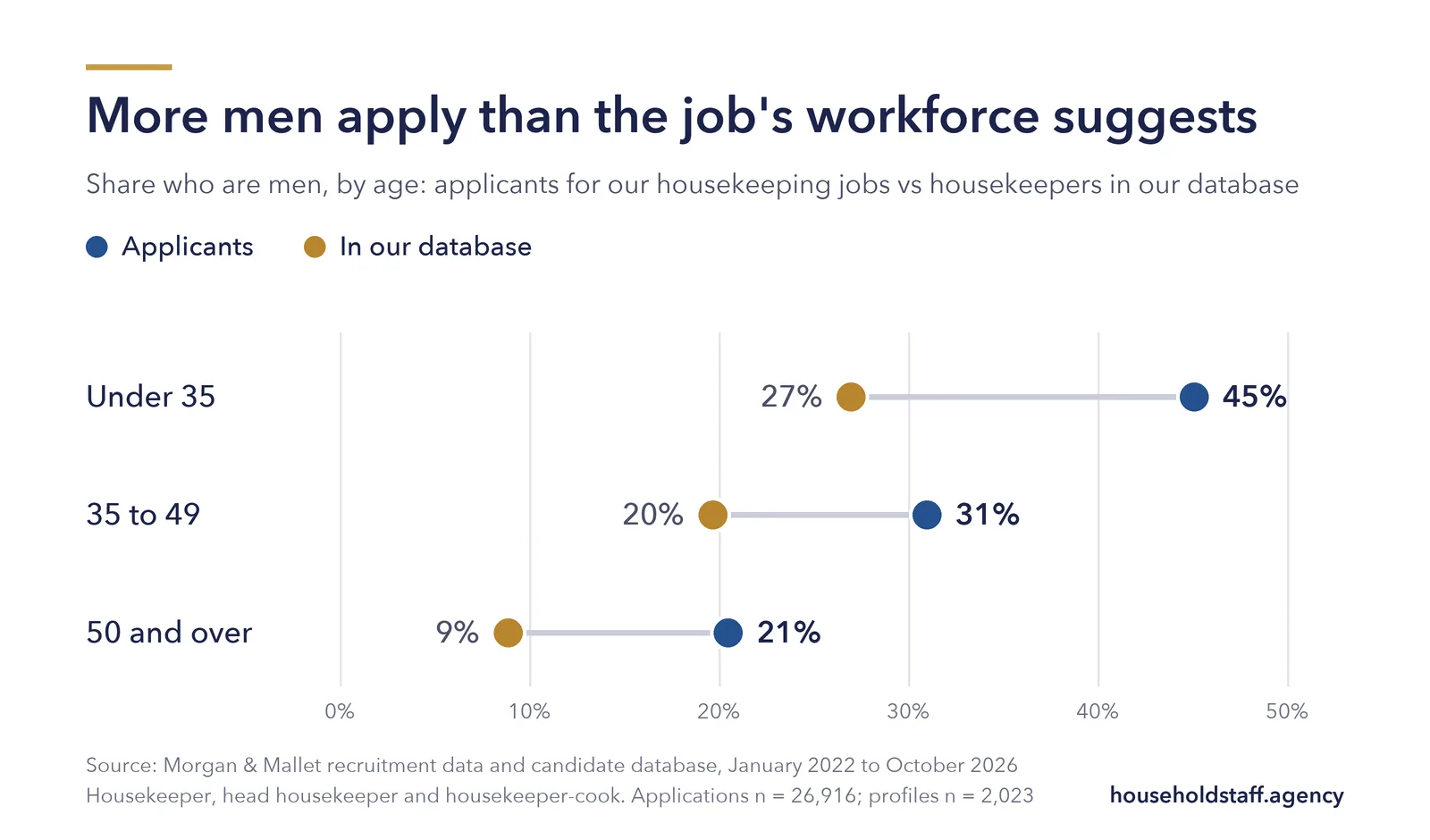
For people aged 35 to 49 it’s 31% of applicants against 20% in our database. For people aged 50 and over it’s 21% against 9%.
Housekeeper-cook jobs attract the most men
Out of the three housekeeping jobs we recruit for, the housekeeper-cook has the highest share of male applicants: 43% of applications come from men.
- Housekeeper-cook: 43%
- Housekeeper: 34%
- Head housekeeper: 32%
A housekeeper-cook looks after a home and also cooks for the family. Our page on hiring a housekeeper-cook explains how the role works.
That isn’t a one-off either. Every year since 2022, between 31% and 37% of applications for these three jobs have come from men.
Where men make up the majority
The UAE is the only market we recruit in where most applicants for housekeeping jobs are men, at 52%.
| Country of the job | Applications from men |
|---|---|
| UAE | 52% |
| United States | 43% |
| United Kingdom | 38% |
| Switzerland | 32% |
| France | 29% |
| Monaco | 29% |
In the US, men make up a bigger share of applicants than across all our markets, in every age group: 48% of those under 35, 41% of those aged 35 to 49 and 32% of those aged 50 and over.
Why do so many men apply for housekeeping roles but far fewer actually work in the role?
We think it mostly comes down to experience, but it could be a number of different factors.
In private households we recruit for, applicants need to be highly experienced.
The male applicants that we get have often not had the chance to amass that experience yet, whereas many of the female candidates have been working as housekeepers for many years.
Our applicant data shows this too, 48% of the men applying for our housekeeping jobs are under 35, compared with 29% of the women. Only 18% of the men are 50 or over, against 34% of the women.
As society has changed, something we see is that it has become more “acceptable” for a man to be a housekeeper.
We think that change is relatively recent, so male housekeepers are catching up in experience terms with their female counterparts.
We also find that more people are seeing housekeeping as a skilled role, and with the advent of AI we see that candidates are moving more into hands-on manual roles in private service.
Men may now look at housekeeping roles as jobs that are safer from AI than perhaps they would have before.
The job market is tough, and men are branching out into new areas. As men gain more experience in housekeeping, we expect to see more of them actually doing the role in private households.
What to keep in mind with our data
- Applications aren’t people. Someone who applied for three of our jobs counts three times.
- Gender and age come from the application form. We counted the 28,081 applications that name a gender, and the 26,916 that also give a date of birth.
- The figures are a snapshot of today’s applicants, grouped by age. They don’t follow the same people over time, so they show how age groups differ now, not how the job has changed.
The database numbers use candidate profiles created since January 2022, when gender started to be recorded consistently by us. Our methodology page explains how we gather and check all our figures.
Sources for all figures on this page: Morgan & Mallet recruitment data and candidate database, January 2022 to October 2026; US Bureau of Labor Statistics, 2025. See how we count.
If a man is on your housekeeping shortlist
Judge him the same way you’d judge a female housekeeper, on the standard of his work, his references, his discretion and how he would fit into how your home works.
A family that only wants to hire women is missing out on more than a third (35%) of applications.
In some homes the split of work between men and women can be just a habit and it’s not necessarily a rule. Laurine Mallet, co-founder of Morgan & Mallet, describes how caretaker couples often divide the work:
“Usually you give the housekeeping duties to the woman. But it doesn’t mean the guy can’t clean.”
Some families prefer a female housekeeper, or a male one, for their own reasons, and that’s their choice. Our housekeeper page explains how we find and vet housekeepers.
Questions people ask
What is a male housekeeper called?
A male housekeeper is called a housekeeper. In a private home the job title is the same for men and women.
You might see “male maid” online, but we find that families and recruiters rarely use it. “Maid” is more often used for cleaning services and hotels, not for staff in a private household.
“Houseman” gets used sometimes too. Some hotels use it for a member of the housekeeping team, and some private estates use it as a job title too.
Is a butler the male version of a maid?
No. A butler looks after the service part of a household. They do things like welcoming guests, serving at table, looking after wine and silver, and often managing the other staff. A housekeeper looks after the whole home.
Both jobs are done by men and women. Our butler page explains the role, and our article on female butlers looks at women in the job.
Do men apply for nanny jobs too?
Far fewer. 8% of applications for our nanny jobs come from men, and 3% of the nannies in our database are men.
Other jobs we hire for go the other way towards men. 96% of applicants for our chauffeur jobs are men, and 79% for private chef jobs.
For journalists: you’re welcome to cite this data with a link to this page. For more detail, email [email protected]. More of our data on housekeepers is in the Morgan & Mallet Household Staff Industry Report.
Looking for a housekeeper for your home? Call us on (646) 965-2308 or get in touch through our website, and we can talk about what your household needs.