



The younger the butler, the more likely she is a woman. Here’s what our data on 700+ butlers shows.
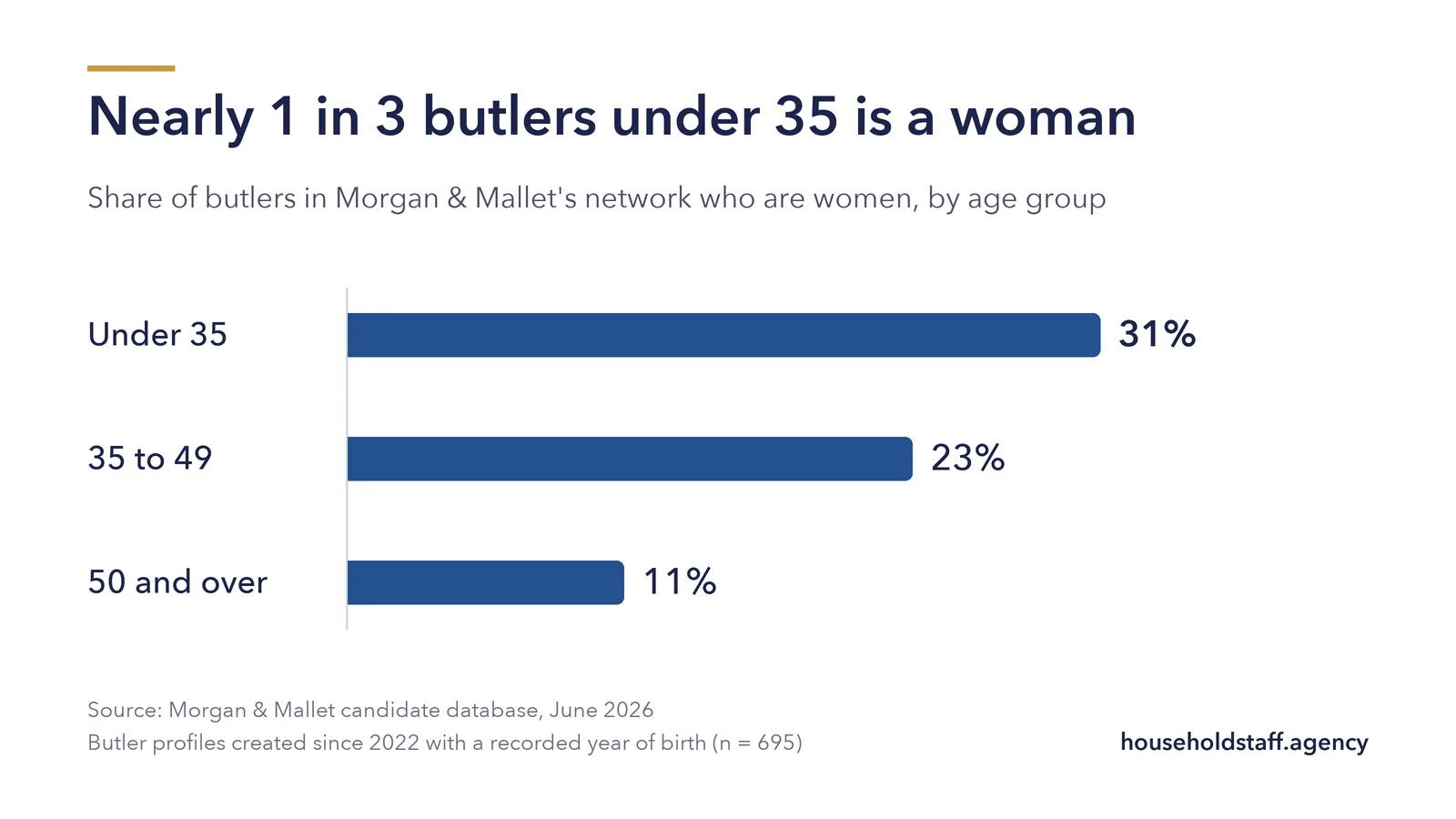
Can a woman be a butler? Yes. Nearly one in four butlers in Morgan & Mallet’s network is a woman. Among butlers under 35, it’s nearly one in three (Morgan & Mallet candidate database, June 2026).
If you ask most people to picture a butler, they are likely to see an older man in a tailcoat. Our data shows that is quite far from the truth today.
Morgan & Mallet, a luxury household staffing agency, places butlers in high-net-worth households across the United States and worldwide. These numbers are from our own candidate database. Job statistics from governments don’t count butlers separately, so data like this isn’t easy to find elsewhere.
What is a female butler called?
A female butler is called a butler. The job title doesn’t change between a man and a woman.
You might find the word “butleress” sometimes, but in our experience families and recruiters don’t use it. “Lady butler” isn’t a title that is used either.
The word butler is very old, and comes from centuries ago. It comes from the word “buttery”, the medieval room where casks of wine and ale were stored. English Heritage says that in most great houses, the butler was the most senior servant.
And today it’s still the same. The Cambridge Dictionary defines a butler as “the most important male servant in a house”.
The dictionary is still using old terms like “servant” and it doesn’t show the way the role has changed.
How many butlers are women?
In Morgan & Mallet’s network, 23% of butlers are women. That’s nearly one in four (Morgan & Mallet candidate database, June 2026).
When we sort them by their age it’s clear to see a pattern.
- Under 35: 31% are women, nearly one in three
- 35 to 49: 23% are women
- 50 and over: 11% are women, about one in nine
The younger age groups have a higher percentage of women.
This breakdown can’t be found in official figures. The US Bureau of Labor Statistics publishes the share of women in hundreds of jobs, but butlers aren’t listed as a job of their own.
But where the government does actually count a household role, it matches our numbers. According to the Bureau of Labor Statistics, 86% of US maids and housekeeping cleaners are women. In our network, 85% of housekeepers are. Chefs are the same: 26% of US chefs and head cooks are women, compared with 22% of private chefs in our network.
It’s useful to check this to show that our database does compare with the real workforce. You can find out exactly how we worked out these figures below under “How we measured this”.
Why are more young women becoming butlers?
The reason comes down to how the role has changed. A butler today does a lot more than just serve at the table. Laurine Mallet, co-founder of Morgan & Mallet, explains this:
“Probably the first thing that distinguishes a modern butler is the presentation. They don’t need specific formal clothes like before. They’re much more versatile and multitask much more. They can do inventory, help with cleaning, go to the dry cleaner. It’s not only table service anymore.”
Some families ask us for a female butler. Female principals, single mothers, and families with young daughters often prefer one, for comfort, security or cultural reasons.
Is the same thing happening in other household jobs?
Yes, but it happens both ways. Jobs that were seen as “men’s jobs” and “women’s jobs” in the household are being taken by both men and women now, especially among the younger household staff.
Almost half of the estate and house managers under 35 in our network are women (48%). Among those over 50 it’s about four in ten.
In housekeeping and personal assistant roles, it goes the other way. Men make up:
- Almost 30% of head housekeepers under 35, against 6% of those over 50
- Nearly a quarter of housekeepers under 35, against 11% of those over 50
- About one in five personal assistants under 35, against 11% of those over 50
Some jobs haven’t changed at all. Only about 3% of chauffeurs in our network are women, and it stays between 2% and 3% in every age group. Private chefs are about one-fifth to one-quarter women at every age, without a clear pattern (Morgan & Mallet candidate database, June 2026).
What does this mean if you’re hiring a butler?
It’s important to hire based on skills and the right fit for you. A family that only considers male butlers is overlooking nearly a quarter of the butlers in our network, and nearly a third of the younger ones.
Think about the job your household needs doing, the level of service you want, whether your butler will manage other staff and if you want them to offer formal service.
The character of the person is as important as the CV. Morgan & Mallet co-founder Morgan Richez says, “It’s easier to teach someone something new than to change their character or education.”
If your family would prefer a female butler, it’s the same. Choose the person with the right skills for your household.
If you’re thinking about hiring a butler, our butler page explains how we find and vet candidates.
How we measured this
These figures are from Morgan & Mallet’s candidate database. They cover everyone in our network who has worked as a butler, or in the other roles mentioned.
The gender numbers are based on candidate profiles created since 2022, when this detail began to be recorded consistently. The butler numbers come from 718 profiles, and the age breakdown uses the 695 that include a birth year.
The figures are a snapshot of our network in June 2026, grouped by age. They show how age groups are different today, rather than how the profession has changed over time.
Journalists are welcome to cite this data with a link to this page. For more detail email [email protected]. More data on butlers is available in our Morgan & Mallet Household Staff Industry Report.
Frequently asked questions
Do female butlers earn the same as male butlers?
The pay of a butler depends on their experience, the size of the household and location. In our 2025/26 Household Staff Salaries Annual Report, US butler salaries are from $90,000 to $180,000 a year, gross. Figures by gender are not published.
Do families ask for a female butler?
Some families do ask us for a female butler. For most families, skills are the first thing they put emphasis on.
Looking for a butler for your home? Call us on (646) 965-2308 or get in touch through our website, and we can talk about what your household needs.